


SHE WAS ALWAYS LATE. Crew members and other actors would wait around for hours, wondering when—or if—Marilyn Monroe would show up. Some days, especially toward the end of her life, she never made it to set at all.
Monroe is famous for her mix of irrepressible sexuality and childlike innocence, but those who knew her in life found her less girlishly naive than tragic and wounded. She drank, took pills, and was constantly seeking reassurance. Toward the end of her life, her frequent overdoses seemed ambivalently deliberate. Her desperation and her sickness mingled, and it is still hard to know exactly whether her death of an overdose in August 1962—naked in her bed, with the phone off the hook as she called friends in a stupor—was precisely a suicide. It was certainly not the first time that she had almost died.
That Monroe was so successful for so long is evidence that her talents were more formidable even than her suffering. Her box office draw was undeniable; so was her magnetism. There is nothing like her on-screen; every eye is drawn to her in every frame. Numerous critics have remarked that with her flawless skin and platinum blond hair, Monroe reflects light. She has a luminous quality that can be almost blinding.
Central to Monroe’s appeal—in her time as in ours—was the stark contrast between her superlative beauty and palpable sadness. On set, directors and producers would scramble to rearrange shooting schedules around her moods, even as she cost them money. Some were enraged by her tardiness. Fox fired her from the film Something’s Got to Give in 1962, eight weeks before she died. Tony Curtis, her costar in 1959’s Some Like It Hot, became so frustrated with Monroe that he said his scenes with her felt “like kissing Hitler.” But others felt bad for her, adopting a kind of pitying indulgence toward the actress. They sensed that whatever was keeping her behind the doors of her dressing room, it was worse for her than it was for anyone else. It was self-doubt, not self-importance. “What am I afraid of? Why am I so afraid?” she wrote in her journal on the set of 1960’s Let’s Make Love. “Do I think I can’t act? I know I can act, but I am afraid.”
What Marilyn often did, during those long hours when she would try to rouse herself and make it to set, was look in the mirror. Paralyzed with fear, she would sit in her makeup chair and stare at herself, sometimes pressing her fingertips against her face. It was both an awed gaze and a paranoid, assessing one. Biographer Charles Casillo called it “narcissism without vanity.” She was famous for her face and body; it must have been strange to remember, alone before the mirror, that they belonged to her.
You can hardly blame Monroe for being overwhelmed by her own image. In her lifetime, she was far and away the most photographed woman in the world, which is another way of saying that she was the most desired. Marilyn Monroe became a movie star in the years following World War II and died just before the social movements of the 1960s permanently altered the face of the nation. Her career was almost exactly contemporaneous with the ’50s, that decade of unparalleled American prosperity and power.
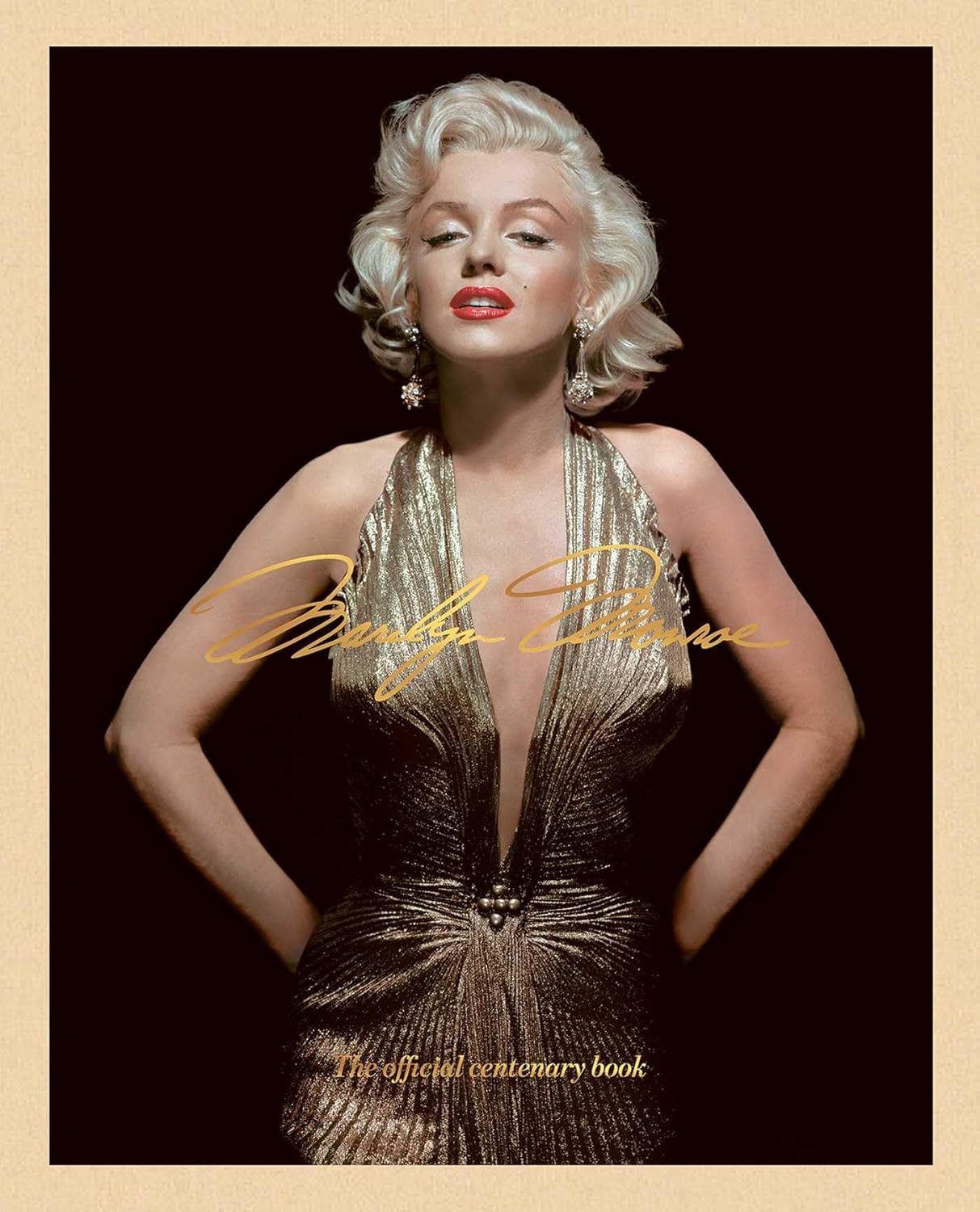
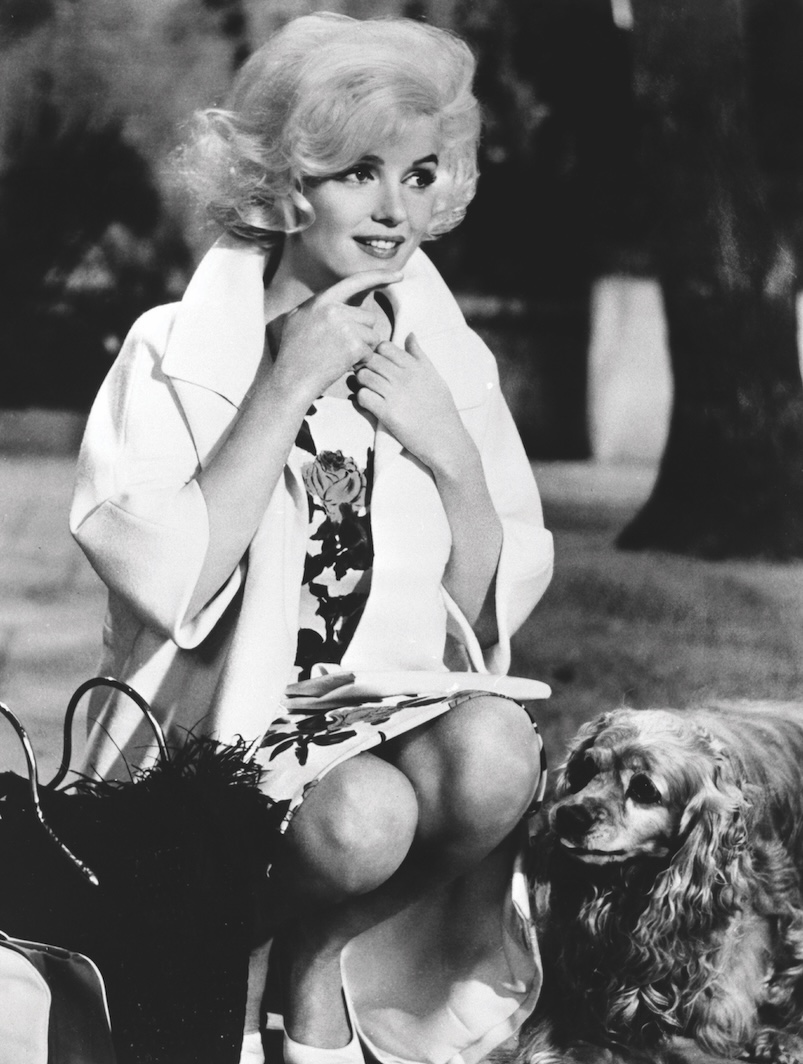
June 1, 2026, the centennial of her birth, offers an excuse for a slew of new reconsiderations of Marilyn. Of these, the marquee title is—what else?—a book of photographs, Marilyn Monroe 100, which marks the actress’s one hundredth birthday with a dense and vivid collection of portraits of Marilyn from her years in the spotlight. In a 1946 snapshot from her early modeling days, as Norma Jeane, she stands with perfect, ruler-straight posture in a pair of plaid culottes. Her hair is still brown and curled in a wartime style; her nose is still slightly flared, before her rhinoplasty. She’s guileless and irrepressibly energetic; her pose has none of the affected languor that characterizes her later portraits. It is shocking how unlike the later actress she looks, how foreign this chipper teenage model is to the later starlet; the young girl is alert, upright, unburdened, and unafraid. A 1962 black-and-white portrait by Allan Grant, published in Life the day before she died, shows Marilyn seated in profile. Her blond hair is coiffed into a perfectly round early-’60s bulb around her head, and she holds her fingers to her mouth in a pose of sexless hesitation, like she’s about to bite her nails. Her false eyelashes seem to clump at the edges, and her mouth is lined at the corners from years of holding a cheesecake grin. The old star is still there, somewhere, but she is tired, distracted. This Marilyn is diminished, no longer the proud young girl ready to meet the world, but an exhausted woman, in need of a respite from it.
In the sixteen years between those two photos, it is hardly a stretch to say that Marilyn—curved torso, sleepy eyes, coiffed hair, parted lips—had become a symbol of America. Marilyn was exported overseas as a vision of the ascendant superpower of her time. In 1953’s Gentlemen Prefer Blondes, her character, Lorelei Lee, literally sails to Europe aboard a sea liner, a transatlantic transit of her smiling face that the critic Jacqueline Rose compared to the postwar cash transfers of the Marshall Plan. A year later in 1954, already tiring of Joe DiMaggio on their honeymoon in Tokyo, Marilyn went to Korea to perform in a USO show for American soldiers stationed there. It was freezing in the February cold, but Monroe insisted on taking off her furs and performing for the men in a sleeveless, glittering blue dress. “This is how they want to see me,” she reportedly said—and, indeed, the more naked she was, the more she seemed to signal what the men were supposed to be fighting for. If women’s bodies are consumable objects, Marilyn’s became, at the peak of her stardom, the ultimate commodity—envied, dreamed of, and burdened with promise. Embodied in Marilyn, America was sex, beauty, and glamour; it was unheard-of levels of consumption and a mass culture of popular appeal; it was a dream of abundance, with legs.
The reach of this symbolism was potent. When Soviet premier Nikita Khrushchev visited the United States in 1959, at the invitation of President Eisenhower, one of his requests was to meet with Marilyn Monroe. Explaining his request to Marilyn, the studio told her, “In Russia, America meant two things: Coca-Cola and Marilyn Monroe.” Were they wrong? In her three most famous roles—as Lorelei Lee in Gentlemen Prefer Blondes, as Pola Debevoise in 1953’s How to Marry a Millionaire, and Sugar Kane in Some Like It Hot—she plays affable and ambitious gold diggers, looking to fulfill rich men’s desires in exchange for a ticket to the top. In a promotional still for Gentlemen Prefer Blondes by John Florea, Monroe stands before a tray of jewelry wrapped in a white fur, her eyes wide and orange mouth pinned into a V-shaped smile as she holds massive diamond bracelets in each hand. There has perhaps never been a more quintessentially American image. Her face contorts with shock in the pleasure of excess, of wealth; of glitter, sex, things. She looks like Bugs Bunny. Monroe agreed to meet Khrushchev, flattered by her status as the emblem of America. “I guess there’s not much sex in Russia,” she quipped.
MAYBE MONROE’S IMAGE has become synonymous with American national mythology in part because her life enacted one of its core plots: the rags to riches story. Born illegitimate in Hollywood to Gladys Baker Mortenson, a twenty-four-year-old mother already in the midst of her second divorce, the baby girl known as Norma Jeane Mortenson never knew her father and was descended, on her mother’s side, from a family with several generations of mental illness. It’s easy to imagine that she would have lived the kind of desperate, dishonorable life of anonymous marginality that so many are doomed to.
As a child, Norma Jeane shuffled between eleven foster homes, plus stretches spent with her mother, during Gladys’s brief periods of stability, and with Grace McKee, her mother’s best friend and Norma Jeane’s eventual legal guardian. Later in life, Monroe would recount desperate childhood fantasies of acquiring loving parents—a father who would visit her in the hospital when she got sick, a mother whose home she would be able to stay in. It is not safe to be so lonely when you’re a little girl. Marilyn said that she was first raped at the age of eight, by an old man who was staying as a boarder in one of her foster homes. Later, after McKee remarried while Norma Jeane was living with her, she reportedly found her new husband fondling the little girl in her bed. McKee’s response was to keep the husband and bring Norma Jeane to an orphanage. Outside the gates, Norma Jeane refused to go inside. “I put my feet down on the sidewalk, they had to drag me in,” she later said in an interview. She protested that her mother was still alive. “I’m not an orphan!” she yelled. “I’m not an orphan!”
Is it any wonder that she greeted sexual beauty, when it arrived, as a godsend? Many girls experience the onset of male attention in early puberty as a disturbing imposition on their movement through the world, the introduction of a new kind of surveillance and threat. To Norma Jeane, it was one of the first times in her life she had been met with something like warmth. At sixteen, she was married off to a neighbor boy, largely because her guardians wanted her out of their hands. But when he went away to war, she found herself alone, independent, and suddenly fielding modeling offers. The rejected child realized that she now had something that people wanted from her, something they liked. When she became an actress, she found this something to be a valuable asset, one that she was more than willing to trade on. Men asked her to smile, and for her, it came easily.
In much the way that historians have dispelled the myth of the ’50s as a peaceful era of racial innocence and gender harmony, so has a vast body of Monroe historiography freed Marilyn from her onetime reputation as a dumb blond. Many of her initial male biographers, such as Norman Mailer, slandered Marilyn as both dissolute and passive, a mere passenger being carried along by circumstance, too vacuous and too crazy to be the author of her own success. But subsequent feminist reconsiderations of Monroe—notably beginning with a 1986 book by Gloria Steinem but including a meticulous 2012 biography by Lois Banner and a famous 2014 essay by Jacqueline Rose—have recovered Monroe as intelligent and clever, possessed of a keen sense of irony, defined political instincts, and a profound sympathy for the downtrodden and disparaged. When you bring her up now to the uninitiated, they are likely to remark, with the satisfaction of someone who expects to surprise you, that she was actually quite smart. A famous 1955 photograph included in Marilyn Monroe 100 shows Monroe lounging in a striped playsuit on a playground, reading a copy of James Joyce’s Ulysses. It was long alleged that the photo was staged. It wasn’t.
Marilyn was burdened by depression and staggering self-doubt; she lived in fear that mental illness would consume her as it had her mother, until it did. But she was also curious, compassionate, generous, nonjudgmental, and possessed of a particular affinity for the working class. Suspecting her of communist sympathies, the FBI trailed her from 1955 until her death in 1962. “Subject’s views,” her file reads, “very positively and concisely leftist.”
But most of all, Monroe was an excellent judge of character. A longtime reader of Freud who was in psychoanalysis for years, she believed that unconscious desires were real and could be revealed with patience and coaxing. She seems to have been unusually good at doing so: Monroe could quickly read what hurt people, what insecurities gnawed at them, and what they wanted from her.
It is more a testament to the uniformity of human desires than it is to the limits of her talents that what most people wanted from Marilyn was the same thing. She became an easeful and expert wielder of her own sexual allure, dispensing favors in a way that often seemed, at least in the beginning, less desperate or needy than savvy and magnanimous. She had sex to say, “thank you”; to say, “I like your work”; to say, “cheer up”; to say, “I’m sorry”; and to say, “hello.” As a young starlet, she became a favorite of photographers, who often expected such favors from their models. Then, she became the mistress of a powerful Hollywood producer: Johnny Hyde. Soon, she had leveraged his love into a real career. “Although Marilyn Monroe cannot fairly be said to have slept her way to the top,” remarked the critic Diana Trilling, “she did at the start of her career sleep her way to the opportunity to work.” Fox would never give her the salary she deserved. But picture by picture, negotiation by negotiation—until one dramatic year, when she quit Hollywood, started her own production company, and moved to New York—she convinced the studio to see her as not just an exploitable starlet, but as an actor whose box office value they had to pay for. By the time she sang into the microphone on that famous night at Madison Square Garden in 1962—“Happy birthday, Mr. President”—her sexual charisma had defined an era of filmmaking.
THERE IS A RUMOR—a piece of gossip, as it were—that for a woman, being sexually attractive is a source of power. There are straight men who will insist on this, telling you that their much younger girlfriends control them totally with the force of their bodily appeal; some feminists, too, have taken up feminine wiles as a potential source of women’s advancement and self-defense. Marilyn’s life can be read as a test of this thesis. By the dint of her genius and the force of her will, she made herself into a synonym for sex itself. Did it get her what she wanted?
Sometimes, yes. It is undeniable that Monroe wielded sexuality to her own ends, often successfully. She not only knew how to provoke people to desire but was often even able to convince them to find their own desires acceptable. In the early ’50s, when the nude model in a popular pinup calendar was revealed to be Marilyn, the scandal threatened to end her career. Instead, Monroe engineered an interview with a female reporter. She breathlessly confessed that the pictures really were her—that she’d had them taken when she was young and poor, and that the photographer had been so professional, and that his wife had been there the whole time, and asked, was there really anything shameful in it? Monroe pulled the interview off perfectly; she played scared and innocent the whole time. The papers printed the story exactly as she wanted it told, and sales of the calendar went through the roof.
But the claim that sex appeal is a kind of power has always sat uneasily alongside the realities of how men inflict their appetites on women. No one, not even someone as brilliant as Monroe, can control what other people do with their desires—perhaps least of all when those desires are for you. Joe DiMaggio, her second husband, wanted to transform Monroe into a housewife; his dream was that she would give up Hollywood and spend the rest of her days watching TV with him on the couch. When her ambitions outpaced his fantasy, DiMaggio turned sour, then violent. After watching her perform the famous subway-grate scene from The Seven Year Itch (1955), he flew into a jealous rage and beat her.
Her third husband, the playwright Arthur Miller, impressed Monroe when he refused to name names in front of the House Un-American Activities Committee during their engagement. But he would not entertain the possibility that Marilyn could be his intellectual equal, and he fixated, with a morbid jealousy bespeaking his own shame, on her sexual past. In his play about their relationship, After the Fall, Miller’s character writes a livid diary entry depicting Marilyn’s character as clownish, vapid, slutty, and stupid—and then leaves the book open in their home for her to find it. The scene was taken from life. Steinem wrote that she had initially disdained Marilyn “because she was a joke, she was vulnerable, she was so eager for approval.” And it is true that Marilyn’s sexual genius seems to have been born from a desperate, depthless need to be cared for; a frenzied effort to gain through sex in adulthood what she had been deprived of by adults in her childhood. But sex is an unreliable route to love, and at any rate, Monroe’s need was too great for any number of lovers to satisfy. Even at the peak of her fame, when she could have any man that she wanted and did, she seems to have been plagued by a feeling of dissatisfaction, of inadequacy, of emptiness. It is tragic that she failed, but you can’t blame her for trying. Perhaps no one learned so painfully that to be loved and to be wanted are not the same thing.
But arguably the greatest tragedy of Marilyn’s life is not that being a sex symbol failed to deliver her love. It is that it prevented her from being anything else. Most of all, Monroe wanted to be taken seriously as an actress. Though she was a box office draw, she was not always appreciated for her distinct comedic gifts; to her frustration, her sexpot persona meant that she was rarely offered roles where she could play anger, or malice, or the kind of suffering that is not picturesque. She fought doggedly with Fox for the right to veto scripts, and to choose which directors she would work with. During her time in New York, she studied the method at the Actors Studio with Lee Strasberg and became close with his family; Strasberg would rank her with Marlon Brando as among his most talented students.
Monroe’s interest in psychoanalysis was born from her own acute mental anguish—she would be committed involuntarily to a psychiatric hospital in New York—but also, and more importantly, from her genuine intellectual ambition. But psychoanalysis was a poor treatment for someone in as much pain as Monroe; her longtime analyst, Ralph Greenson, integrated her into his own family in a wrongheaded attempt at reparenting, but seemed unable to help Monroe develop the capacities that would have helped her gain genuine self-respect—like the ability to show up for work. Perhaps it’s just as well: the psychoanalysis of Monroe’s time, with its heavy emphasis on women’s supposed inferiority, could do nothing to heal the kind of suffering that their degraded status caused. Meanwhile, her study of the method, for all it might have lent confidence to her performances, did not earn her what she craved most: esteem as an artist. “Of the cruelties directed at this young woman, even by the public that loved her,” wrote Trilling, “it seems to me that the most biting . . . was the mockery of her wish to be educated, or thought educated.” “Actress must have no mouth,” Monroe famously wrote in her notebook. Her job, her role, her function was to be a screen, white and luminous, for other people’s desires, other people’s ideas. It was not to have her own. In this way, Marilyn became a casualty of the very myth she worked so hard to create. “Do I think I can’t act? I know I can act, but I’m afraid,” she wrote. She was not only talking about her job; she was articulating the double bind of the sex object, whose task is to work very hard, with tremendous tenacity and concentration, to create the appearance of being totally passive.
Who could survive long in such a trap? Women whose bodies are made to carry all this symbolism often lead lives marked by madness, addiction, dysfunction, and violence; think, for a moment, of Marilyn’s heirs, the likes of Princess Diana or Britney Spears, who suffer under the impossible contradictions of their own fame. For her part, Monroe was prescribed sleeping pills for anxious insomnia during her marriage to DiMaggio—and overdosed on them repeatedly. During the last years of her life, she was consuming mostly barbiturates and champagne. “No amount of acting, however inspired,” Andrea Dworkin wrote of Monroe, “can convince the actor herself that her ideal female life is not a dreadful form of dying.”
From the vantage point of 2026, the tragedy of Monroe’s life lies in its foreclosed possibilities. What if, while being an object of desire, she had been allowed to be anything else? What if, confronted with the force of her beauty, her audience had been strong enough to see her also as a mind—grieving, brilliant, needful, and struggling? It is hard to avoid the thought that just as Marilyn became a symbol for her country at the height of its power, so might her decline mirror that of the nation she came to represent—one whose government, as she was becoming a star, was working diligently to extinguish communism, to resist integration, to expel homosexuals, and to prescribe, quite narrowly and punishingly, only one version of what the country could be. For her part, Monroe saw clearly the analogy between her constrained career as an actress and the aborted possibilities of American political life. At the outset of her stardom, after being stopped on the road by police in Los Angeles one night in 1949, Monroe learned that the cops were looking to break up a meeting of suspected communists at a nearby house. She asked the officers, “Who is this sheriff of yours, Hitler?” Monroe immediately rushed to warn the group. “I hoped there was something kind of behind the scenes worrying about things, not just letting them get away with all the stuff they do to us.” She added, “A struggling young actress like me knows about that.”
Some of the last photographs ever taken of Monroe were shot by Bert Stern for Vogue in June 1962, weeks before her death from an overdose of alcohol and downers at her home in Brentwood. Stern took some 2,500 photos over the course of an afternoon and published them in a 1982 book called The Last Sitting. In the pictures, Marilyn sports a peroxide bouffant and modish makeup—white eyeshadow with a heavy crease line, a colorless lip. Monroe was drinking heavily during the shoot, and her eyes bear a glazed expression, gauzy and vacant. She wears costume jewelry, scarves, and little else. Modern sensibilities cast these photos in a different light—how ethical is it to take nude pictures of someone so drunk?—as does the fact that Marilyn crossed out many of the images on the contact sheet, drawing great big red Xs over photos where she looked tired, or where the camera captured the scar that ran across her abdomen from an endometriosis surgery. But the portraits are transfixing, precisely because they show her famous fragility on display. Her skin is papery and loose; she has deep lines at the corners of her mouth; drugs and grief are aging her hard. And still, she is magnetic, radiant. In one photo, Monroe’s right eye is covered by a falling swoop of hair, and a string of beads hangs across her chest. She is visibly drunk. She raises a champagne coupe to her mouth and grins. Whatever she was looking for, that’s the closest she came to finding it.
Moira Donegan is a columnist at The Guardian and a writer-in-residence at Stanford’s Michelle R. Clayman Institute for Gender Research.