


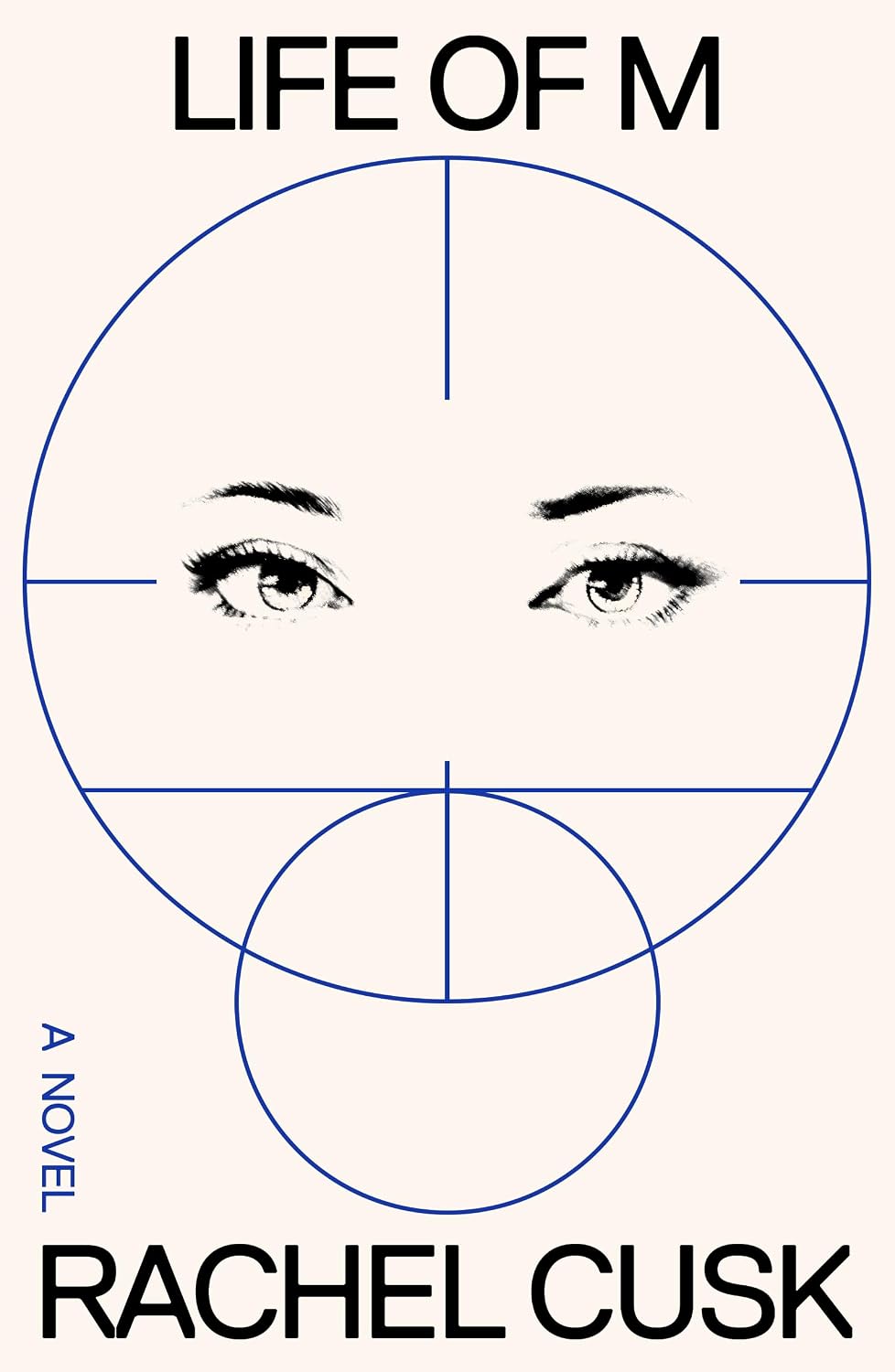
I WENT TO A BOOKSHOP in Montreal and saw that the bookseller had Rachel Cusk’s new novel, Life of M, open on the counter beside the till. Did she like it? She loved it, going on for some minutes about the way Cusk illuminates objects and other non-subjects before arriving at a notion, a concept, which she gave its French name: l’infra-ordinaire. “Oh, Perec,” I said, as if playing Celebrity. (Celebrity is a game in which the players try to guess famous names, working first from description, then from association.) But as soon as I had “won,” I felt I had cheated, and, so she wouldn’t think I was knowing on my own account, confessed to her the nature of my occupation.
Cusk’s novels are beloved in the “book world,” where they often are set. Faye, who narrates the Outline trilogy, goes from workshop to panel to festival. Reading Kudos, you could almost believe in this world where, even though it is the twenty-first century, the most famous and praised people are authors of literary fiction. But in Life of M, Cusk mercilessly breaks this illusion. Her protagonist, a film star, is known to everyone, while her narrators have no names and barely have faces. I think this explains why much of the critical reaction has felt animated by something deep, like betrayal. It is betrayal. If even the most celebrated woman writer feels small and “unimportant” beside her celebrity subject, how faceless are we?
Some perspective is in order. Parul Sehgal, reviewing Life of M for The New York Times Magazine, recalls a talk in Paris at which Cusk spoke longingly of those who do what she, in Sehgal’s damning paraphrase, called “menial” work, for instance the work of bus drivers. “Imagine the simplicity of those lives,” Sehgal remembers her saying. Sounds bad. Yet because I had the bookseller’s thoughts in my head, I did not, when I read this, picture Cusk at a window, looking out or down upon the bus drivers. I saw her on the couch, reading Perec. I saw her doing a Perec thing. When, in the ’70s, the experimenting realist sat in the cafés of the Place Saint-Sulpice to watch and record “what happens when nothing happens other than the weather, people, cars, and clouds,” he found himself most jealously watching the buses. “The rest seems random, improbable, anarchic,” he wrote in the resulting book, whereas the buses are “foreseeable,” destined.
Life of M could have another title, one word apart from Perec’s: An Attempt at Exhausting a Self in Paris. On the second page, we hear that M’s difficulty “lay in her distance from the random violence of insignificance.” Cusk implies a violence that is always, by its nature, random, and from which only personal significance—fame?—offers shelter. In reality, violence is only random for the winners in a class system, who are perhaps likelier to see themselves as destined; for the losers, it runs on a fixed route, as Perec well understood when he wrote, in his essay on the infra-ordinary, that “what is scandalous isn’t the pit explosion, it’s working in coalmines.”
Perec’s Marxist commitment to the quotidian and his Oulipian distaste for spontaneity gave motive and interrogative force to his leveling method. He taught his readers to examine the material conditions of their lives and even to see material itself as conditional, to “question . . . bricks, concrete, glass.” Cusk seems to be following his method, forcing herself to see things flat: “The city is beautiful. It is a masterpiece of civilisation. At some point in the modern era a big ugly tower was built here, the only one of its kind. . . . The same instinct that created the city’s beauty also created this tower, except in reverse.” Yet she loses her readers in the immaterial. What instinct? Whose? A social contradiction has become a random, reversible image, like a tarot card pulled by a nonbeliever.
Cusk’s career bloomed in a time when “lived experience” was becoming the measure of not only subjectivity but also authority, making some writers wonder what other kinds of experience there could be. She seems to ask sincerely: Can experience be not lived? Can it actually be unlived? The form of Outline, at which she arrived by subtracting herself, basically, like so much clay, is so natural that it hardly seems made; she made disappearing look easy. Her latest works are proof that it is otherwise. Though not set out as such, Second Place, Parade, and Life of M can be read as another trilogy, this one about dysphoria: in the classical sense of finding experience hard to bear and in the newer, clinical sense, which concerns gender. Both senses emerge right away in the third book of this new unofficial trilogy. “It was hard not to feel ugly next to M,” we hear from our cipher. “Part of it was the ugliness of experience. I had never learned how to make experience easier for myself.”
The tragedy of D. H. Lawrence, wrote Angela Carter, was that “he thought he was a man,” as Janique Vigier recalled in her review for this magazine of Second Place. Cusk’s tragedy is that she thinks she has to be a woman, irrespective of desire or aptitude. Her quarrel with fate was clear in Aftermath, her insubordinate divorce memoir, and then submerged, as she rose to the status of a latter-day sibyl, through the years of the Outline trilogy. After Kudos, she said that she no longer felt gendered. But dysphoria riddles her plots. It is when the narrator of Second Place tires of sex that she looks to a painter, L, to refigure her, in what she calls a “spiritual scheme for evading the unevadable, the destiny of the body.” This does not work: “I can’t really see you,” he says. In Parade, a painter named G gets pregnant and sees “a dreadful truth, the truth of her female caste,” come “slowly and inexorably into view.” The baby is a “girl.”
This corporeal self-loathing reaches a frenzied peak in Life of M, as when the plot of one of the star’s films is reinscribed:
She wants to be the wild ballerina, so much that it might be said she desires her. But she is not her; she cannot be her, and nor can her desire for her be satisfied, because the inalterable laws of being—so confusing, sometimes, for M to grasp—forbid it. What to do then with this container, this source of all limitation, the body? Murder and mutilate it, tear out its eyes.
Might be said, but can’t be. For Cusk, to admit desire into the frame would expose the myth of female powerlessness, or the agreements between women to keep some of their power obscured. It would be to betray what Charles Mauron, E. M. Forster’s French translator, called a writer’s personal myth: “a small number of dramatic scenes, whose action is as characteristic of the writer as the actors.”
Cusk always being on the verge of some exposé is part of what makes her compelling, even when her subjects bore. She is also experimental in her own way, boiling down decades of British and now French avant-gardism into “easier” books while retaining their spirit of linguistic inquiry and their suspicion of character. It feels a little dispiriting, then, how much of the discourse around Life of M has centered on how she may personally feel about a richer, more famous woman: Is she jealous? Is she resentful? Is she being too mean? Now Cusk knows what it is like to be a critic.
OBJECTIVITY, FOR CUSK, is born of objectification. Early in Life of M, the first of our narrators describes “a book by a woman who had been sexually abused by her stepfather throughout her childhood,” marveling that the writer’s tone had “the authority of an object. It was as if some household item—a chair, for instance—had suddenly gained the power to speak.” Even or especially an objective authority is not innate; the narrator has already said of themselves and M that “it was the ways in which we had been damaged that had given us our power.” A page later, we learn that the writer, as a child, knew that a few words could destroy her family and kept silent: “It was no more possible for her to say those words than it would have been for a chair.”
Cusk’s chair is a phantom chair. It belongs at a phantom table, the instructive figure of the old philosophical exercise in Virginia Woolf’s novel To the Lighthouse. Lily, the painter, is told to think of a kitchen table “when you’re not there,” that is, to imagine the world without herself in it. She does this and sees the table upside down, like the paintings in Parade. The literary scholar Ann Banfield took up this figure in The Phantom Table (2000), showing how Woolf advanced “an unseen vision which reflects the abolition of the subject but not of its object,” whose “literary correlate is the disappearance of the author.” Woolf’s table appears when no one is looking. Cusk’s chair speaks when no one is listening.
Cusk in Parade raises the question of whether a novel can be narrated by a non-person or some kind of non-being. One of the Gs, a novelist, rejects his own form because he finds it too “resistant to dissociation from the self.” This is because a novel has to be narrated: “A novel was a voice, and a voice had to belong to someone.” Eventually he goes into film, believing that behind he cannot be seen and so can be free.
Like Parade, Life of M has different narrators. An “I” narrates the frame; a “we” or an “it” narrates the rest. Parts about M mostly alternate with parts from the life of this unnamed, unstable “we,” which sometimes sounds to me like a dyad—author and narrator—and at other times more like a demographic.
Reviewing the novel for the New Left Review’s blog, Sidecar, Ryan Ruby wrote that “the genus Cusk’s collective narrator represents in miniature is the upper-middle class.” Cusk has already been offered a larger “we.” On stage in London in 2022, Merve Emre reminded Cusk that she had once said she did not think character existed any more, a remark that Emre had taken to mean that the novel needed “to shatter ego in order for its voice to get at something more elemental, a substratum of being and becoming that is shared among everyone in this room, that doesn’t require people being fully individuated or subjectified.” Cusk seemed not to register this offer and went back to complaining about character, which, she said, takes the novel “through so many successive stages of a kind of cloning of itself.” In the novel, cyclists who make their own rules “operate through character”; late in the book, the “we” say of themselves, “We do not operate any longer through character, and nor do we cycle through the city.” It is almost as if, for Cusk, class were an escape from character.
The parts of the book that would seem to be about M have neither an “I” nor a “we.” In Banfield’s terms, a narrator who says “I” is a speaker, even with no one to speak to. Sentences of third-person narration have no speaker, but they can still have a subject, someone whose thoughts and perceptions are represented in them, as in Flaubert or Woolf. In a sentence with neither, things would appear with no one there to see them, like the phantom table.
The M sections have a “she,” which suggests that their sentences are speakerless but not subjectless. These sections can be read as recognizably modernist free indirect discourse, or as the assumptive close third of a ghostwriter. But there is also an objective or objectified “she.” For instance, there will be three pages setting up a scene, in this case at a spa, and then: “The elevator doors slide open and reveal M.” Either M is so self-conscious or so narcissistic that when the doors open she thinks, I am being revealed, or consciousness and perception are being given to non-subjects in the novel. Since a few pages earlier we were given to see the empty rooftop pool from the stated vantage point of the birds, I would say it is the latter.
So there are sentences in Life of M that are both speakerless and subjectless, yet in them things are told and shown subjectively. More striking still: those speakerless sentences in which there is both a conscious subject and a self who does not share that consciousness. “Someone inside her,” Cusk writes of M, whose relative has been struck by a car, “was watching the whole thing unmoved.” This is a little chilling, with its implication of a split personality, or a double consciousness, or maybe—possession. Near the end, the “I” narrator shows M a draft of the book we are reading and justifies the decision to write it, not even to M but to us, by explaining that they had needed to “go and live in someone else.” The narrator then recounts seeing M on television, and experiencing a recognition that they could not bear. “It was as though the being in which I was attempting to live was refusing to host me any more.”
In “Making Home,” an essay collected in Coventry (2019), Cusk wrote, “Entering a house, I often feel that I am entering a woman’s body.” In Life of M, she reverses this figure, disappearing into the rooms. Fifteen scenes in the M sections begin with the same kind of sentence: “It is a hotel room in a foreign city.” “It is a practice room at the back of an old theatre.” “It is a restaurant, hidden away down a passage.” This too is new— presentationally and impersonally, that is to say in a view without its point. Cusk all but states the method when the “we” wish they could see their friends “as a hidden camera would see them, alone at home, when they thought themselves unobserved.”
Cusk’s vanishing standpoint marks a departure in style and substance from all the “I said” and “I asked” of the Outline trilogy. It brings her nearer to the nouveau roman. Christine Brooke-Rose invoked Barthes’s famous question—qui parle?—when introducing a reissue of Brigid Brophy’s In Transit (1969), an experimental novel about a narrator who loses their gender in an airport. Borrowing a phrase from the linguist Émile Benveniste, she wrote that in the early novels of (Perec’s sometime antagonist) Alain Robbe-Grillet, as in her own, “literally ‘no-one speaks.’” In those novels, she observed, there is “no first person, only a poised description of all that is being seen, heard, supposed, and we have to construct the character out of that.” This is unlived experience, writing like a ghost.
Gallery, New York, Gisela Capitain, Cologne, Raffaella Cortese, Milan and Maxwell Graham, New York.
M USED TO BE N—N as in Narrator, as in Natalie, as in Natalie Portman. (There is a leaked manuscript of the book in which the letter N appears accidentally three times in place of M, seemingly the result of an incomplete find-and-replace pass.) The ethics of this relatively short leap are whatever to me. I’m more interested in the technique, namely the exophora through which Cusk tries to displace self-consciousness. She is always playing some game of “guess who.” Here is a partial list of people, places, and products she defines without designating: Akira Kurosawa’s Drunken Angel. Ingmar Bergman’s Persona. Aristotle Onassis. Miss Dior. Darren Aronofsky’s Black Swan. Francesca Woodman’s photographs. Chanel’s literary salons. Rachel Cusk.
I sometimes think Cusk leaves out proper nouns for the same reason fashion designers eschew buttons on bias-cut silk: too many capital letters would ruffle the purity of the line. A more substantive reason might be that she is chasing “pure experience,” which William James defined as “a that which is not yet any definite what.” Proper nouns do irrevocably turn that into what—or worse, into who. But Cusk, quite unlike James, conflates identity with character, giving rise to certain textual ironies, if not contradictions. Her narrators are bemused by the “bright and sleek” cafés that are suddenly “everywhere”—outposts of a new global ordinariness—because they look devoid of history yet are always full: “perhaps people find the absence of character easier.” Yes, so do her readers. There is commercial value in her refusal to properly name things, which is also a refusal to historicize. It makes her novels feel instantly timeless.
Her novels also increasingly affect an air of placelessness. In Outline, Faye is in Athens; in Transit, she is in London. In Kudos, Cusk began to name only the places where her narrator was not. Extending the practice, she now implies her narrators could be anywhere, from everywhere. By Life of M, Paris has become “the city.” Nationalities appear as adjectives: a coffee machine “of an Italian brand,” boots with “Cuban heels,” and “an antique Persian rug.” The exception is India, where the masseur who treats M has been on “travels for research.” Cusk can name the world’s most populous country without denoting a place or its people because she is writing in English, the language of trade and derogation. Cuban heels. Persian rug. India self-discovery trip.
The aim of all this may be to anonymize or universalize, but the effect is parochial and so, paradoxically, identifying. Cusk can see flatly for a while, can do away with depth and hide perspective, yet her sense of proportion inexorably reveals the subject position of her “we.” Someone who uses the phrase “a force of occupation” to refer to tourists has probably not moved to Paris from Warsaw. (Or from Jerusalem, where Portman was born, in a place her family calls Israel. Imagine Cusk naming that entity—“we” would have to say where we stand.)
In Life of M, it is seldom clear who or what makes anything happen. Of the turning point in M’s career, Cusk writes that “M chose or was chosen by cruelty,” and a few pages later, “In choosing cruelty, or being chosen by it.” This is a big “or.” It covers the difference between free will and fate.
Cusk has trouble with consequence at the sentence level too, sometimes: “M does not eat pastries. She doesn’t know what would happen to her if she did. It is this inversion of cause and effect—there is no effect because there is no cause—that seems to differentiate her life from the lives of other people.” A reader of Cusk’s light, fluid prose ordinarily has no cause, or leaves no time, to question her meaning. But this last line—and it is not the only one in the novel—stopped me for a full minute before I realized it would never make sense. One, causality is right there in the word “because.” Two, this is not inversion, this is negation.
Jamie Hood ended her 2024 review of Parade for this magazine by describing “a quiet hour” at a Francesca Woodman exhibition in New York, where she overheard an older woman telling a friend about Woodman’s early suicide: “If only she could have taken a few days to just breathe.” Cusk’s “we” stand before the same photographs and say much the same: “We wish she hadn’t died. We wish we could have helped her, consoled her, shown her how to stay alive.” Hood, as the moment passed, felt “as if I’d woken to find myself in the pages of some other woman’s novel,” which indeed she did, in a way, two years later.
IF THE CURE FOR DYSPHORIA in its classical sense is to decreate the self, as Simone Weil would say, it makes sense that gender, one of the first things assigned at birth, is the last thing to go. A child is declared a girl or a boy before anyone names the child; Cusk withdraws the two in reverse, the name first, then the sex. One way to read Life of M is as a story about becoming unsexed in the presence of a real woman, that is to say an actress, or through a mirroring, contradictory relationship to her performance of womanhood.
At their last meeting, M says that the way the “I” narrator portrays her is “hurtful.” “But it isn’t you,” the narrator answers. “It isn’t anyone.” Later, M says, “Obviously you can do what you want. But I don’t want you using my name.” (Want, in the first instance, is the wrong word. We are dealing with a compulsion.) As the narrator goes down the front steps into the dark street, M calls out: “This might sound stupid . . . but I’ve been wondering. Are you a guy or a girl?”
It does sound stupid. Why “guy or girl,” and not “man or woman”? The tone (never mind the content) is too gauchely American, making the ending seem undignifying, an ugly joke. Several reviewers ignore it and call the “I” narrator “she.” Others suggest that readers will ineluctably do the same. No one can imagine a man who envies women? Brophy imagined indifference. By the end of In Transit, “It no longer matters a damn of course whether ‘I’ is masc. or fem.” Cusk cannot go that far—it matters a great deal to her class—so she leaves the question open.
A book too full of self is also too gendered. When Cusk in 2014 declared autobiography to be “increasingly the only form in all the arts,” she was echoing—with a new, dispassionate valence—the complaint made by William H. Gass two decades earlier. “An honest autobiography is as amazing a miracle as a doubled sex,” he wrote in Finding a Form, “and every bit as big a freak of nature.” Then: “To have written an autobiography is already to have made yourself a monster.” In the Book of Common Prayer, wherever a name must be said aloud, there is an N, for nomen. The letter for a woman at the marriage service is N. For a man, it’s M. Some commentators explain the M as the abbreviation of the plural, nomina, two N’s that a printer set side by side. N doubled for “monster.”
“Being a creator,” Cusk writes, “was like being a dog that keeps running away from its violent master. For a while it runs free, it runs and runs in search of something, but in the end there is nowhere else for it to go but back home.” Freud’s name for this inevitable turning back was the repetition compulsion, by which a person returns, again and again, to the scene of an injury, or of a crime. It’s funny that writing a memoir does not protect you from this compulsion to repeat. Well, and that’s because writing a memoir does not legally require you to remember or to record what actually happened, or why. In Life of M, Cusk returns to the time she recorded in Aftermath, and to the time before that, her unhappy childhood. It is her own body that seems too ungainly for ballet. It is her own parents who “threaten her with some ultimate exile from the safety of blood ties.” Possibly, at the level of the unconscious, she wished that if she used an actress to enact her longest-steeped grievances and deliver her bitterest lines, people would hate the actress and not her. (Perhaps she underestimated the American investment in celebrity.)
Twice Cusk writes that M made her choices “at the peak or in the trough of her life.” Cusk was forty-five when she published Aftermath, which made everyone hate her and augured another divorce, that being from her narrative self. Portman, whose own divorce was finalized in 2024, is forty-five now. Cusk may assume, rightly or wrongly but not without evidence, that Portman will be smiling through it all, unlike herself, who was destroyed.
Except she wasn’t destroyed; or rather, her seeming ego death precipitated a creative rebirth, such that she became one of the most famous novelists in the Western world, not only famed but adored. It is possible that the adoration forms part of her “unbearable corporeality,” since she is adored simultaneously for representing a female point of view and for not being herself. In my own adoring review of Kudos, I said that she wrote “selfless autobiography” when I probably meant egoless, and in any case was speaking in the optative. Anyone who has earnestly tried to live without an ego knows that the attempt will sooner leave you homeless than free you. A property owner is not going to dissolve the boundaries of the self—be serious. Trying to conjure a more realistic expectation for a novelist who, because of her status and readership, now carries a certain amount of responsibility for the fate of the novel itself, what comes to mind is how Simone Weil expressed her ambition: “To put oneself in the place of someone whose soul is corroded by affliction, or in near danger of it, is to annihilate oneself. It is more difficult than suicide would be for a happy child.”
Outside the brasserie, a waiter stands with his arms folded, watching a boy across the street. “What is it like,” the waiter or the actor but really the writer wonders, “to be a simple boy sitting on a step smoking a cigarette?” By “simple,” I think Cusk means less gendered, therefore less self-conscious. There is also a fatal class character to her gaze on the boy, condemned, by her view, to a life outside narrative. I wish she would take her own questions seriously, try writing that book. It could be beautiful.
Sarah Nicole Prickett is a writer and editor living in Montreal.